How Deep Is a Kitchen Counter – A Practical Guide
Trying to find the perfect kitchen counter depth can feel overwhelming—you’re not alone. Many people struggle with balancing enough workspace while keeping the kitchen comfortable and functional. Whether you’re remodeling or designing from scratch, understanding how deep a kitchen counter should be is key to creating a space that works for you.
A standard kitchen counter is usually 24 inches deep, providing a perfect balance between workspace and comfort. Depending on your cooking zones, depths can vary: deeper for prep, shallower near the stove, and standard by the sink.
Appliance size, material thickness, and kitchen layout also influence your choice. Custom depths help maximize space or fit unique needs.
Keep these in mind, and you’ll design a kitchen that works smoothly and looks great. Investigate how to tailor your counter depth further for your ideal setup.
Key Takeaways
- Standard kitchen counters are typically 24 inches deep. This size balances workspace while fitting standard appliances and cabinets.
- Prep areas benefit from deeper counters, usually 25 to 27 inches. That extra depth helps with organization and gives you more workspace.
- Shallower counters, around 22 to 24 inches, work well near cooking zones. They improve accessibility and reduce the strain from reaching.
- Material thickness and weight play a role in choosing counter depth. They affect durability and how well the counters align with cabinets.
- Custom counter depths are great for optimizing space in small kitchens. They also accommodate unique appliances or ergonomic preferences.
What Is the Standard Kitchen Counter Depth?
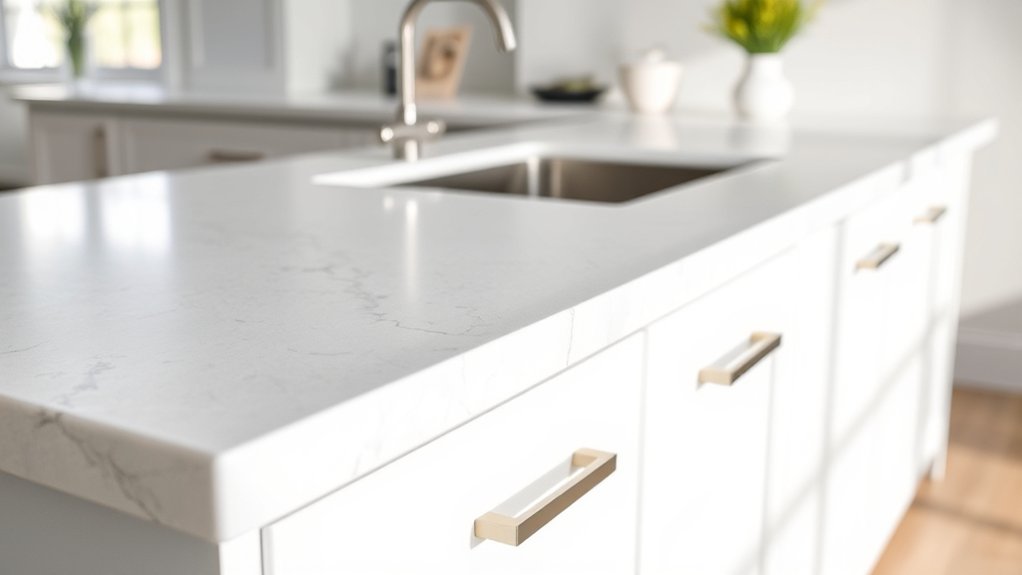
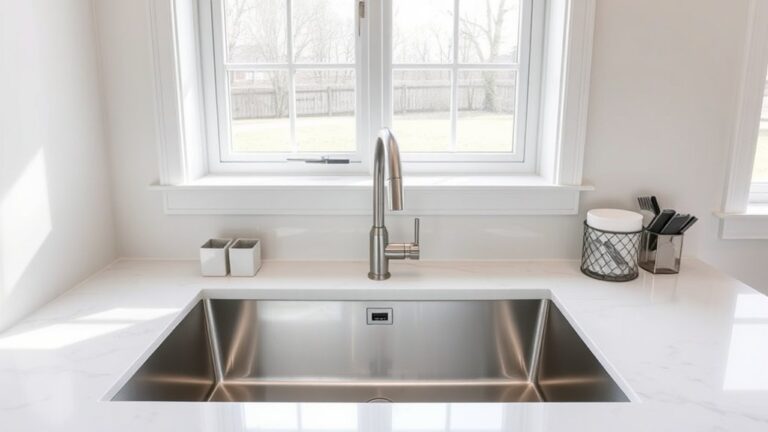
While kitchen counter depths can vary, the standard depth you’ll most often find is 24 inches. This size strikes a balance between providing enough workspace and fitting comfortably within most kitchens.
The standard kitchen counter depth is 24 inches, offering ample workspace while fitting well in most kitchens.
When you consider counter height, it usually stands around 36 inches, making it ergonomic for most people to prep food without straining. If you’re choosing a counter color, keep in mind that lighter shades can make your space feel larger, while darker tones add a sleek, modern touch.
Remember that the standard 24-inch depth supports a variety of appliances and sinks, ensuring you don’t run into fitting issues. This depth also works well with common cabinet sizes underneath, which means your kitchen will look cohesive.
If you’re remodeling or designing a kitchen, sticking close to this standard depth helps maintain functionality and aesthetic appeal without complicating installation or usage.
How Kitchen Counter Depth Impacts Workflow and Storage
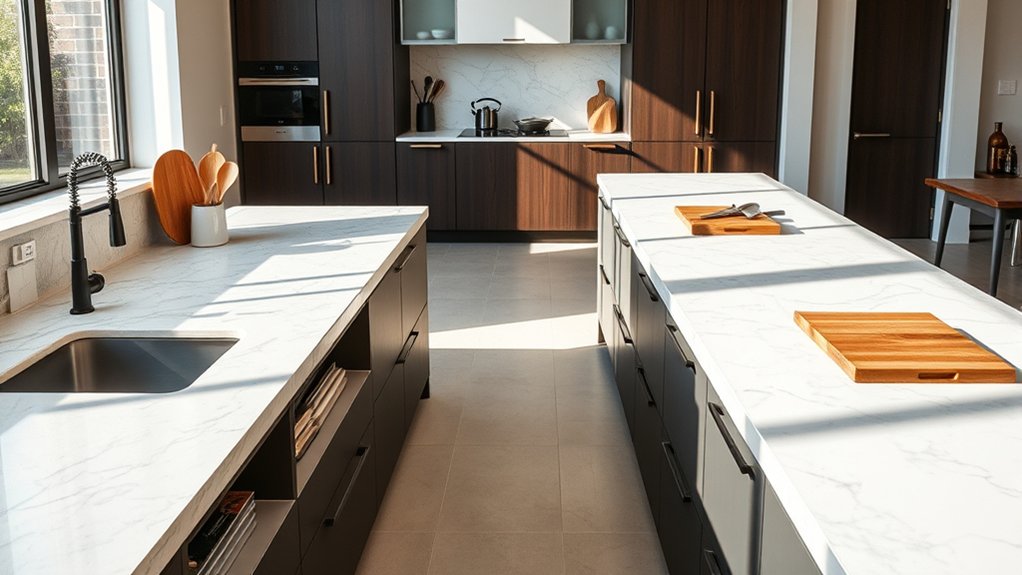
You’ll find that the depth of your kitchen counter directly affects how smoothly you move while cooking and prepping. When your counter is deeper, it gives you more space to spread out your tools and ingredients. This can really boost how efficiently you work in the kitchen.
Plus, a deeper counter often means extra storage options underneath. That’s super helpful for keeping your kitchen organized and clutter-free. So, it’s not just about having more space on top, but also making the most of the space below.
Workflow Efficiency
Because kitchen counter depth directly affects how you move and organize your space, it plays an essential role in workflow efficiency. When your counters are too deep, you might find yourself reaching awkwardly, slowing down meal prep.
Conversely, shallower counters keep everything within easy reach, speeding up your tasks. Pairing the right depth with thoughtful lighting options ensures you see clearly, reducing mistakes and fatigue.
Furthermore, coordinating color schemes with your counter’s depth can influence how spacious and inviting your workspace feels, subtly boosting your productivity. Bright, reflective surfaces paired with adequate lighting make it easier to focus, while darker tones might make a deep counter feel cramped.
Storage Optimization
A kitchen counter’s depth plays a crucial role in how you optimize storage and maintain an efficient workflow. Deeper counters offer more space for storing items underneath or placing organizers. Shallower ones encourage minimalism and quick access.
Balancing depth with smart storage solutions, color coordination, and lighting design can transform your kitchen’s usability and aesthetics.
| Counter Depth | Storage Options | Workflow Impact |
|---|---|---|
| 18 inches | Slim drawers, shelves | Quick reach, compact |
| 24 inches | Standard cabinets | Balanced access |
| 30 inches | Deep pull-outs, bins | More storage, less reach |
How Appliance Size Affects Kitchen Counter Depth Choices
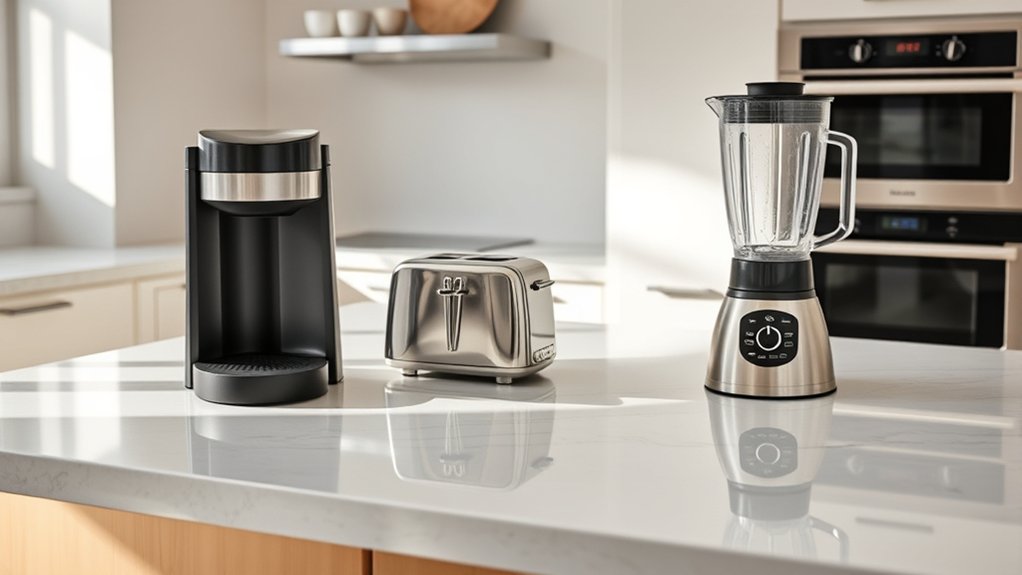
Several key appliances, like refrigerators, ovens, and dishwashers, play a major role in determining the ideal depth for your kitchen counters. When planning your kitchen, you need to take into account appliance placement carefully to ensure smooth workflow and aesthetic harmony.
For example, if your refrigerator extends beyond the typical counter depth, you might want shallower counters nearby to prevent a cramped feel. Likewise, ovens and dishwashers often require counters that align perfectly with their front edges, so you don’t end up with awkward gaps or overhangs.
Counter height also influences your counter depth choice. Taller counters paired with deeper surfaces can feel overwhelming, while lower counters with standard depth maintain comfort and usability.
Keep in mind that your appliances’ dimensions and how they fit within your kitchen layout will guide your decisions. By balancing appliance size with counter depth and height, you can create a functional, streamlined kitchen that feels spacious and works efficiently.
How to Choose Counter Depth for Small and Large Kitchens
When you’re picking out the counter depth for your kitchen, the first thing to think about is how much space you actually have. It’s also important to consider how you plan to use that space day-to-day.
Standard depths usually do the trick for most kitchens, but if you’ve got a smaller or larger area, going custom can really make a difference. It helps you make the most of every inch, whether you’re tight on space or have room to spread out.
At the end of the day, you want a layout that works well for how you cook and where you like to store your things. So, focus on what feels functional and comfortable for you.
Space Optimization Tips
Although kitchen counter depth might seem like a minor detail, it plays a crucial role in how efficiently you use your space. When optimizing your kitchen, consider how color schemes and lighting techniques can improve the perceived size.
Lighter colors and reflective surfaces make counters feel more spacious, while strategic lighting brightens work areas without crowding the room. In small kitchens, choosing a shallower counter depth can free up walking space, but balance it with adequate workspace.
For larger kitchens, deeper counters provide more prep area without feeling overwhelming. Remember, your goal is to create a functional flow that complements your kitchen’s size. By combining smart counter depth choices with thoughtful color and lighting, you’ll maximize both usability and comfort.
Standard vs Custom Depths
Choosing the right counter depth can make a big difference in how comfortable and efficient your kitchen feels. Standard depths usually range from 24 to 25 inches, fitting most kitchens and allowing enough workspace without crowding. If you have a small kitchen, sticking to standard depths helps keep the space open and functional.
For larger kitchens, custom depths give you extra surface area, which is great for prepping or entertaining.
When choosing between standard and custom depths, consider your counter height too. Taller counters might pair better with deeper surfaces for comfort. Don’t forget the edge profile, as it affects both style and safety.
A rounded edge profile might feel more comfortable with deeper counters, while a sharper edge suits standard depths well. Choose what fits your space and lifestyle best.
Functional Layout Considerations
To optimize your kitchen’s functionality, you’ll want to tailor your counter depth to the room’s size and how you use the space. In small kitchens, shallower counters save room for movement while still providing enough surface for meal prep. In larger kitchens, deeper counters offer extra workspace and storage options.
Consider how your color schemes and lighting fixtures interact with counter depth. Lighter colors and well-placed lighting can make deeper counters feel less bulky. Conversely, darker tones and poor lighting may overwhelm a compact space.
Think about your daily routine. Do you need space for multiple cooks or just quick meals? This practical approach guarantees your layout supports your lifestyle, maximizing both comfort and efficiency in your kitchen.
Why Kitchen Ergonomics Depends on Counter Depth
When you spend time cooking or prepping food, the depth of your kitchen counter directly affects your comfort and efficiency. If your counters are too deep, you might strain to reach items, causing unnecessary discomfort.
Conversely, shallow counters limit your workspace, making tasks feel cramped. Proper counter depth supports natural movements and reduces bending or stretching.
Ergonomics also tie into your kitchen’s overall design. Color palettes and lighting fixtures influence how visually comfortable and inviting your space feels, encouraging you to work efficiently.
Bright, well-placed lighting fixtures reduce eye strain on deeper counters, while cohesive color palettes can create a sense of openness, making the workspace feel less confined.
When to Choose Custom Kitchen Counter Depths
Balancing comfort and workspace often means standard counter depths just won’t suffice. You might need custom kitchen counter depths when your space demands more than typical sizes or when you want to highlight decorative accents and unique color schemes. Custom depths let you tailor the workspace to fit your cooking style and kitchen flow perfectly.
Consider these scenarios:
| Situation | Why Custom Depth Helps |
|---|---|
| Limited Kitchen Space | Maximizes usable area without crowding |
| Unique Appliances | Ensures counters fit around them seamlessly |
| Bold Color Schemes | Improves visual harmony and style |
| Showcasing Decorative Accents | Provides space to highlight design details |
| Personal Comfort | Matches your reach and working posture |
When you choose custom depths, you optimize both function and aesthetics, making your kitchen truly yours. It’s about creating a space that feels right and looks stunning.
How Kitchen Counter Depth Varies by Prep, Cooking, and Cleaning Zones
Although kitchen counters often look uniform, their ideal depth changes depending on whether you’re prepping, cooking, or cleaning. When prepping, you’ll want a deeper counter to spread out ingredients and tools comfortably, usually around 25 to 27 inches deep. This extra space helps you stay organized and efficient.
For cooking zones, a slightly shallower depth, about 22 to 24 inches, works better since you need easier access to stovetops and appliances without stretching too far. Cleaning zones, near sinks and dishwashers, often benefit from standard depth counters, around 24 inches, to prevent water splashes and allow comfortable counter height for scrubbing dishes.
Edge profiles also play a role here. Rounded or eased edges reduce discomfort during lengthy prep or cleaning sessions. Remember, counter height remains consistent across zones to maintain ergonomic comfort, typically 36 inches, but depth adjustments tailored to each zone improve your workflow and kitchen experience.
How Countertop Materials and Thickness Affect Kitchen Counter Depth
When you’re picking out a kitchen counter, you’ll see that the thickness of the material can vary quite a bit. This thickness actually plays a big role in how deep your countertop ends up being.
Thicker surfaces usually mean more durability, which is great for everyday use. But keep in mind, they also add extra weight, and that can impact how deep your countertop can go.
Material Thickness Variations
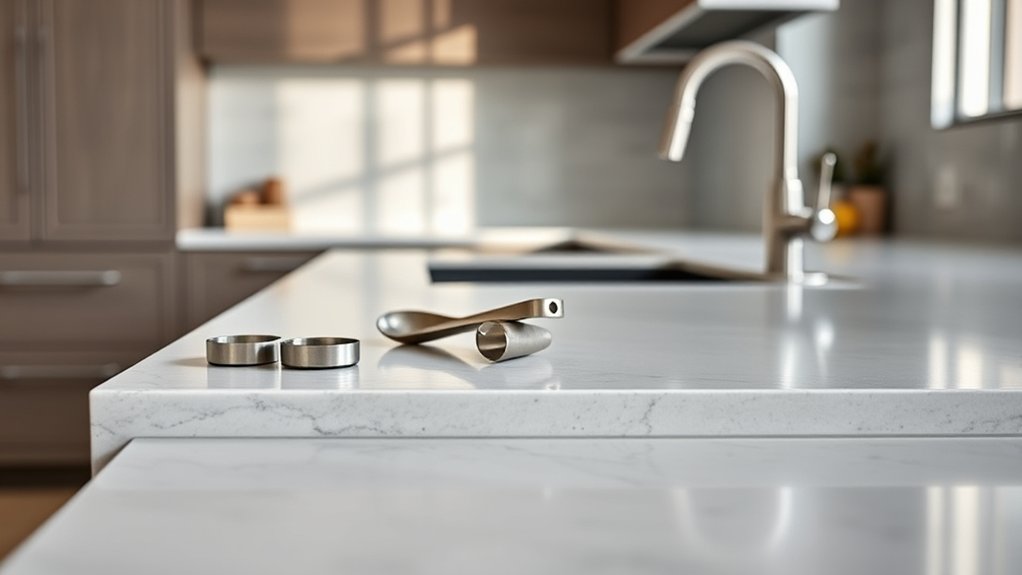
Countertop materials come in various thicknesses, and these differences directly influence the overall depth of your kitchen counter. For instance, granite slabs often range from 2 to 3 centimeters thick, while laminate counters are usually thinner, around 1.5 centimeters.
When choosing your countertop, consider how thickness affects counter height. Thicker materials will raise the surface, potentially impacting cabinet and appliance alignment. Your edge profile choice also plays a role. Thicker edges can add visual weight and bulk, making counters appear deeper.
If you opt for a beveled or bullnose edge, the thickness can subtly shift the perceived depth. Ultimately, balancing material thickness with counter height and edge profile guarantees your countertop fits both functionally and aesthetically within your kitchen space.
Depth Impact On Durability
Since the materials and thickness you choose directly influence how deep your kitchen counter feels, they also play an essential role in its durability. When selecting your countertop, consider that thicker materials generally provide better resistance to wear and warping, especially with heavier use.
Edge profiles also impact durability; rounded or beveled edges tend to resist chipping better than sharp edges, which can be more fragile over time. Furthermore, your counter height affects how the depth feels and functions. Taller counters might require sturdier materials to maintain stability.
Balancing depth with material strength and edge design ensures your kitchen counter remains both practical and long-lasting. Keep these factors in mind to create a durable workspace that suits your daily needs and style preferences.
Surface Material Weight Effects
Although you might not immediately consider weight, the material and thickness you choose considerably affect how your kitchen counter feels and performs. Heavier materials like granite or quartz require sturdy support and influence your counter height and edge design choices.
Thicker slabs add weight but provide durability and a luxurious feel, while thinner surfaces keep counters lighter but may limit depth options.
| Material | Approx. Weight (lbs/ft²) |
|---|---|
| Granite (2 cm) | 12 |
| Quartz (3 cm) | 18 |
| Laminate (1 cm) | 4 |
| Marble (2 cm) | 15 |
| Concrete (3 cm) | 20 |
Choosing the right balance between material weight, counter height, and edge design ensures a stable, functional, and stylish kitchen.
Tips for Measuring and Planning Your Kitchen Counter Depth
When planning your kitchen counter depth, start by measuring the available space accurately to guarantee a comfortable fit. Use a tape measure to check the distance from your cabinets to any obstacles like walls or appliances. Don’t forget to account for overhangs, which affect usability and safety.
Next, consider how your kitchen’s artistic decor and lighting design influence the counter’s depth. For example, deeper counters can showcase decorative backsplashes or under-cabinet lighting more effectively. Also, think about how lighting design impacts your workspace visibility; proper illumination complements counter depth, making food prep easier.
Finally, sketch your layout to visualize how the counter depth fits with the overall kitchen flow. By carefully measuring and planning with these factors in mind, you’ll create a kitchen counter that’s both practical and stylish, perfectly suited to your space.
Balancing Style and Function When Choosing Kitchen Counter Depth
Choosing the right kitchen counter depth means finding the perfect balance between style and function that suits your daily needs. You want a depth that offers enough workspace without overwhelming your kitchen’s flow. Think about how you use your counters daily, whether it’s prep, cooking, or display, and let that guide your choice. Decorative accents and color coordination also play a big role in creating a cohesive look that feels inviting and practical.
Here’s a quick guide to balancing style and function:
| Feature | Consideration |
|---|---|
| Workspace | Deeper counters for prep space |
| Traffic Flow | Shallower for tight kitchens |
| Decorative Accents | Integrated for style |
| Color Coordination | Match counters with backsplashes |
| Appliance Fit | Depth must accommodate devices |
Frequently Asked Questions
How Do Kitchen Counter Depths Vary Internationally?
You’ll notice that counter depth standards vary widely due to international kitchen dimensions. In the US, counters typically measure 24 inches deep, while European kitchens often feature shallower depths around 22 inches to save space.
In some Asian countries, counters can be even narrower. When designing or renovating, you should consider these variations to make certain your kitchen fits local ergonomic and spatial norms perfectly.
What Is the Impact of Counter Depth on Kitchen Resale Value?
You’ll find that counter depth considerably impacts your kitchen’s resale value. When you invest in counter customization, you add design flexibility that appeals to buyers, making your kitchen stand out.
Standard depths work for most, but tailored options can maximize space and functionality, boosting appeal. Buyers appreciate thoughtful layouts, so customizing counter depth can increase the perceived value of your home.
This can help it sell faster in a competitive market.
Are There Eco-Friendly Materials Suitable for Deep Kitchen Counters?
Imagine running your hands over a smooth, deep kitchen counter crafted from eco-friendly materials like reclaimed wood or bamboo. You’ll find sustainable countertops not only look stunning but also minimize your environmental footprint.
Materials such as recycled glass or concrete mixed with natural pigments offer durability and style while being kind to the planet. Choosing these options lets you enjoy a spacious kitchen surface that’s both functional and eco-conscious.
How Does Counter Depth Affect Kitchen Lighting Options?
Counter depth directly impacts your kitchen lighting options because deeper counters can create shadows, especially if your counter height is standard or taller. You’ll need more focused task lighting, like under-cabinet LEDs, to brighten work areas.
Plus, deeper counters often mean increased storage capacity, so you might have more overhead cabinets that affect light placement. Modifying your lighting plan ensures your workspace stays well-lit and functional regardless of counter dimensions.
Can Kitchen Counter Depth Influence Cleaning Product Choices?
You might not realize it, but yes, kitchen counter depth can influence your cleaning product choices. When you have deeper counters, you’ll need products that support better counter organization, so everything stays accessible and neat.
Shallower counters demand efficient solutions that maximize every inch, boosting cleaning efficiency. Choosing the right products tailored to your counter depth helps you maintain a spotless kitchen without hassle, making your routine smoother and more effective.
Conclusion
So, you’ve learned that kitchen counters aren’t just flat surfaces. They’re the unsung heroes of your culinary adventures. Who knew depth could make or break your workflow, storage, and even your comfort?
It’s almost ironic that something so simple demands so much thought. But now, armed with this practical guide, you’re ready to pick the perfect depth. One that balances style, function, and maybe even your sanity.
Happy countertop hunting, and here’s to finding the ideal kitchen counter depth for your space!